Student groups stage demonstrations in Delhi demanding urgent government action over severe air pollution
Student organisations held separate protests in the national capital to demand immediate government intervention and accountability regarding the deteriorating air quality.

- NSUI and SFI student groups held separate protests in Delhi over worsening air quality.
- Demonstrators demanded accountability from both the Delhi and Union governments.
- SFI highlighted reported AQI levels crossing 3,000 on Diwali night and raised concerns over missing monitoring data.
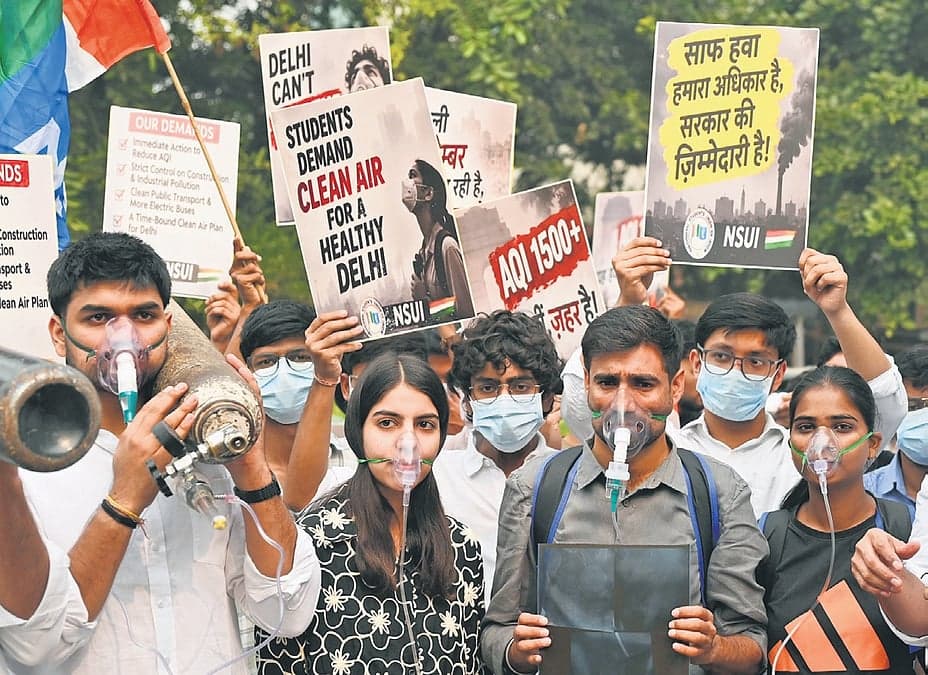
Student organisations took to the streets in the national capital to register their opposition against the worsening air pollution levels. Demonstrations were organized to demand urgent measures from authorities to tackle the recurring public health crisis and safeguard public well-being.
NSUI Demonstrates on Raisina Road
The National Students’ Union of India staged a demonstration at its headquarters located on Raisina Road. Led by national president Vinod Jakhar, members and students participated in the march while holding oxygen masks to their faces and carrying placards with the message, “Students demand clean air for a healthy Delhi.”
Addressing the gathering, Jakhar stated that the heavy air had placed the health and everyday lives of ordinary citizens in serious danger. He noted that children, senior citizens, and millions of residents were forced to breathe toxic air daily, adding that responsible agencies had failed to deliver concrete solutions despite repeated warnings.
SFI Protests at Delhi University
Separately, the Delhi University unit of the Students' Federation of India organized a demonstration at the Arts Faculty. The group questioned the failure of both the Delhi and Union governments to address the deteriorating air quality index.
During the demonstration, the organisation pointed to a reported spike in pollution levels on Diwali night, during which the air quality index was claimed to have crossed 3,000. Concerns were also raised regarding alleged missing data from pollution monitoring stations during peak pollution hours, with the group questioning the overall transparency of the monitoring mechanism.
Critique of Government Response
Both student groups criticized authorities for offering recurring excuses, advisories, and temporary restrictions every winter. They argued that the pollution crisis was not merely a seasonal or meteorological problem, but rather the consequence of unregulated urbanisation, construction activities, vehicular emissions, and industrial pollution, alongside the neglect of public transport and environmental safeguards.
The organisations emphasized that clean air should be treated as a fundamental right rather than a privilege determined by an individual's financial means. While affluent residents could afford air purifiers or relocate, students, children, workers, and street vendors remained continuously exposed to hazardous conditions.
Demands and Administrative Actions
The student bodies called for swift, effective, and time-bound measures, demanding transparent monitoring, strict enforcement of regulations, and a comprehensive public health response. They warned that they would continue to raise the issue until concrete steps were taken by the responsible agencies.
Meanwhile, the Gautam Buddh Nagar administration directed officials to strictly enforce a ban on construction and demolition activities under the third stage of the Graded Response Action Plan, issuing warnings of action against any violators.
- Protests were led by NSUI president Vinod Jakhar and the DU unit of SFI.
- Student groups blamed unregulated urbanisation, vehicular emissions, and industrial pollution for the crisis.
- Authorities in Gautam Buddh Nagar ordered a strict ban on construction under GRAP-3 rules.
- Student organisations took to the streets in the national capital to register their opposition against the worsening air pollution levels.
Spotted an error? · Our editorial policy
UP NEXTSarfaraz Khan Details Emotional Toll of Dressing-Room Leak Allegations and Gambhir’s SupportOther angles · #air pollution
Timeline →- NewsDelhi’s Air Quality Hits ‘Poor’ at 279 With Several Areas Entering ‘Very Poor’ Zone
- NewsDelhi Air Quality Nears Very Poor Bracket as Calm Surface Winds Trap Pollutants
- NewsDelhi Schools Resume Physical Classes Following Withdrawal of GRAP Stage-III Restrictions
- NewsCitizens’ Delegation Visits Environment Ministry Office to Demand Air Pollution Action
More from Environment
Delhi Records Season’s Coldest Morning as Air Quality Remains in ‘Poor’ Category
Delhi registers coldest morning of the season with temperature dipping to 11.6 degrees Celsius

Deep Depression Intensifies Into Cyclonic Storm Akvan Over Bay of Bengal