New Study Examines Potential of Chinese Spaceplane Constellation for Rapid Global Access
A recent academic study explores how a proposed fleet of forty reusable Chinese spaceplanes could initiate descent toward locations worldwide within minutes, coinciding with the release of a US intelligence photograph depicting a secretive orbital vehicle.

- A study by Northwestern Polytechnical University researchers explores a constellation of 40 reusable spaceplanes capable of initiating descent globally within minutes.
- The US Defence Intelligence Agency released an image on October 26 of what is widely believed to be China's Shenlong spaceplane in orbit.
- The photograph was captured on May 28, 2024, by a commercial imaging satellite from a distance of under 90 kilometers.
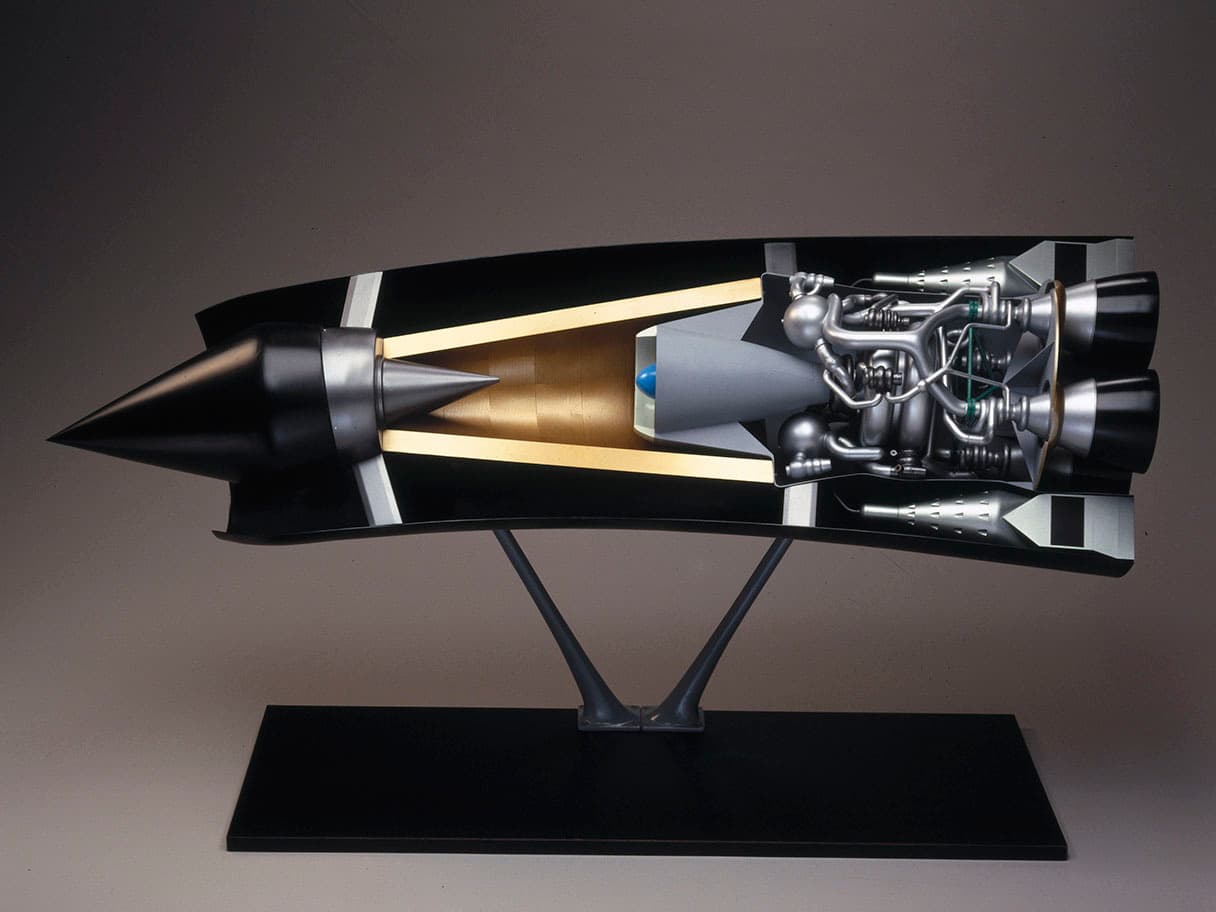
Photo: Science Museum London / Science and Society Pictur / Wikimedia Commons (CC BY-SA 2.0)
A recent computer-simulated study conducted by researchers at Northwestern Polytechnical University in Xian has evaluated the feasibility of a proposed constellation of forty reusable spaceplanes. Led by Du Chongrui at the institution's School of Astronautics, the research indicates that such an orbital fleet could allow a spacecraft to begin descending toward any point on Earth following a maximum wait time of two and a half minutes.
Published on October 30 in the peer-reviewed journal Acta Aeronautica et Astronautica Sinica, the findings state that for the majority of populated areas globally, the necessary waiting interval could be reduced to approximately one minute. The study clarifies that these short figures represent the maximum duration required to find a suitable orbital opportunity to initiate a return journey rather than the total flight time needed to reach a destination.
Potential Applications and Strategic Implications
While Beijing describes its experimental reusable spacecraft initiative as a project intended to make space access more convenient and affordable, the research highlights various potential applications. These include high-speed global transportation, emergency response capabilities, and potential military uses such as space-based strikes.
The study notes that vehicles stationed in orbit would not require a terrestrial launch after receiving an operational order, allowing descent maneuvers to commence as soon as orbital positioning permits. Such vehicles could potentially approach targets from multiple directions and maneuver during atmospheric flight, which could present challenges for conventional detection, warning, and missile defense systems.
US Intelligence Agency Image Release
The research findings emerged concurrently with the release of a photograph by the US Defence Intelligence Agency on October 26 as part of its Challenges to Security in Space report. Captured on May 28, 2024, by a commercial imaging satellite operated by Vantor and built by Maxar Technologies from a distance under ninety kilometers, the image provides a view of what is widely believed to be China's secretive Shenlong spaceplane.
The photograph depicts a delta-wing vehicle featuring open payload bay doors and rear-mounted equipment. The physical configuration bears similarities to the uncrewed Boeing X-37B spaceplane operated by the United States military, which is designed for extended orbital stays and runway landings.
China's Reusable Spacecraft Program
Chinese authorities have maintained a limited disclosure policy regarding the design and operational capabilities of the program. Since 2020, the nation has executed four missions involving its experimental reusable spacecraft, with the most recent launch occurring in February.
According to the US Defence Intelligence Agency report, Chinese orbital vehicles have previously demonstrated proximity operations. During a second mission spanning 2022 to 2023, the spacecraft maneuvered alongside a companion satellite, while a subsequent mission in 2023 to 2024 involved releasing and interacting with an external object. These capabilities can facilitate satellite inspection, deployment, and servicing, alongside potential military applications involving intelligence collection or interference with other space assets. Neither Beijing nor US defense officials have officially confirmed that the spacecraft photographed by intelligence assets is the Shenlong.
- Computer simulations indicate spaceplanes could begin descent to most populated regions in about a minute.
- The US defense report highlights similarities between the Chinese delta-wing vehicle and the American Boeing X-37B spaceplane.
- Previous Chinese space missions have demonstrated satellite deployment, retrieval, and proximity maneuvering capabilities.
- A recent computer-simulated study conducted by researchers at Northwestern Polytechnical University in Xian has evaluated the feasibility of a proposed constellation of forty reusable spaceplanes.
Spotted an error? · Our editorial policy
UP NEXTMax Verstappen inherits Las Vegas Grand Prix pole after Kimi Antonelli penaltySwipe more stories · WorldQuick cards, a few lines each. Tap to open.