SpaceX Successfully Catches Orbiting Starship Spacecraft with Launch Tower Arms in Historic First
SpaceX achieved a major aerospace milestone by recovering an orbital-class Starship spacecraft using the mechanical arms of its Texas launch tower after a 22-hour mission.

- SpaceX successfully caught an orbital Starship spacecraft using launch tower mechanical arms at Starbase, Texas.
- The spacecraft completed 14 orbits over 22 hours and deployed 26 Starlink satellites.
- The Super Heavy booster failed its tower recovery attempt due to low fuel mass and diverted to the Gulf of Mexico.
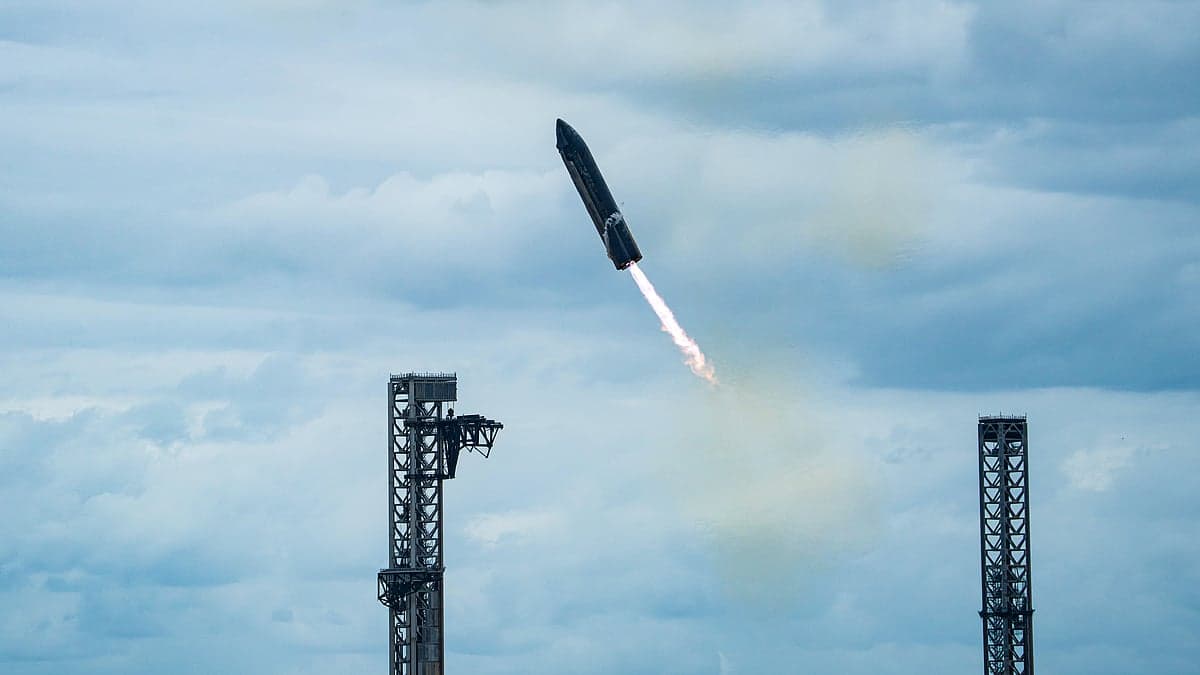
The aerospace enterprise executed an unprecedented recovery manoeuvre at its Starbase facility located in Boca Chica, Texas. Following a flight lasting approximately twenty-two hours, the upper-stage spacecraft returned from Earth orbit and was secured mid-air by massive mechanical arms attached to the launch structure. Company representatives and public figures acknowledged the feat as a critical advancement in the development of fully reusable rocket systems.
Fifteenth Test Flight and Mission Profile
The operation took place during the fifteenth test flight of the heavy-lift vehicle configuration. The vehicle lifted off from Pad 2 propelled by thirty-three Raptor engines on its first stage before executing a hot-staging separation. The upper-stage spacecraft then utilised six Raptor engines to continue its trajectory into space, completing fourteen complete orbits around the planet during its extended spaceflight.
Payload Deployment and Orbital Operations
While circling the globe, the spacecraft released twenty-six advanced Starlink satellites at an altitude measuring roughly 161 miles or 260 kilometres. Flight controllers monitored onboard systems throughout the extended orbital phase before initiating the return sequence. Contact was established with the deployed payloads shortly after separation as the units began raising their operational orbits to integrate into the existing constellation.
Atmospheric Re-Entry and Precision Descent
The return journey commenced with the ignition of a single Raptor sea-level engine to execute the deorbit burn. The vehicle navigated through intense thermal pressures generated during atmospheric re-entry over the designated trajectory toward the Texas coast. Navigational systems guided the craft above the Gulf of Mexico before three Raptor engines reignited to perform a controlled vertical flip and deceleration manoeuvre.
Launch Tower Capture Mechanics
Upon approaching the launch facility, large steel mechanical arms colloquially termed chopsticks or Mechazilla secured the descending vehicle in an upright position. Company executives and commentators highlighted the engineering difficulty of recovering an upper-stage structure returning from high-altitude and high-speed orbital environments compared to conventional vertical landings.
Booster Recovery Challenges and Investigation
Despite the successful capture of the upper stage, the Super Heavy first-stage booster experienced anomalies during its descent sequence. The booster initiated a directional boostback burn using thirty-two engines, but the operation concluded prematurely due to insufficient fuel mass detected by onboard telemetry. An automated abort protocol diverted the structure toward an offshore aquatic landing zone in the Gulf of Mexico.
Future Implications for Deep Space Exploration
The overarching objective of the vehicle development programme remains the complete reusability of both primary rocket components to reduce operational expenditures and hardware waste. NASA intends to utilise a modified iteration of the spacecraft as a lunar lander to support Artemis missions. Programme engineers continue addressing technical hurdles such as heat shield refurbishment and orbital propellant transfer capabilities.
Official Responses and Industry Reactions
Chief Executive Officer Elon Musk expressed appreciation to engineering teams via social media platforms following the successful landing. Administrator Jared Isaacman also issued public statements congratulating the organisation on the milestone. Technical teams stated that data gathered from the flight will inform future vehicle iterations and test schedules.
- The upper-stage Starship returned from orbit and was caught by mechanical arms nicknamed Mechazilla.
- The mission successfully deployed 26 advanced Starlink satellites into orbit.
- The Super Heavy booster experienced an early engine cutoff and splashed down in the Gulf of Mexico.
Spotted an error? · Our editorial policy
UP NEXTSarfaraz Khan Details Emotional Toll of Dressing-Room Leak Allegations and Gambhir’s SupportOther angles · #SpaceX
Timeline →- NewsSpaceX Completes Historic Starship Orbital Catch Using Mechazilla Tower Arms
- NewsUkraine Accuses SpaceX of Dishonesty Over Starshield Drone Limits
- NewsSpaceX Successfully Captures Starship Spacecraft Using Mechanical Arms in Historic Milestone
- NewsSpaceX Completes First Midair Capture of Orbiting Starship
More from Technology

Anthropic Researcher Claims AI-Assisted Proof for the Riemann Hypothesis
Grand Theft Auto VI Becomes Largest Entertainment Launch in History

Trump Backs Jensen Huang’s Return to Nvidia Amid Board Resistance and Intelligence Scrutiny